Content Localization: Managing Multilingual Digital Signage
Master multilingual content management for global digital signage deployments with TelemetryOS localization tools and cultural adaptation strategies.
When your digital signage serves diverse audiences speaking different languages, effective localization ensures everyone receives clear, culturally appropriate information in their preferred language.
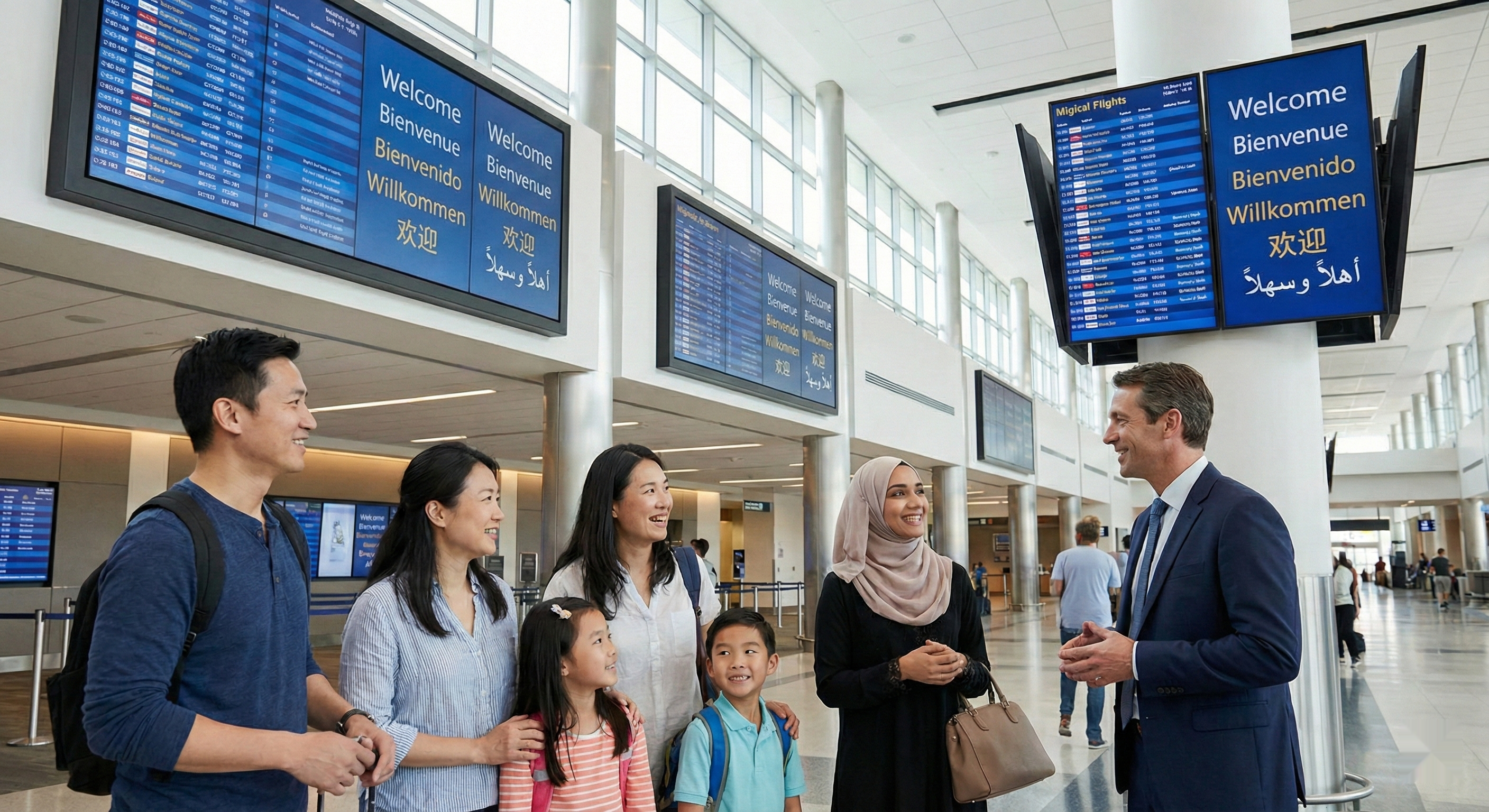
Content Localization: Managing Multilingual Digital Signage
A hospital deploys wayfinding displays across three campuses serving communities where 40% of patients speak Spanish as their primary language, 15% speak Mandarin, and another 8% speak Tagalog. Those displays need to show directions in the reader's language automatically, not force non-English speakers to puzzle through unfamiliar terms while navigating an already stressful environment. Getting localization right determines whether those screens actually help the patients who need them most.
The challenge goes beyond translation. Color symbolism varies across cultures: white signifies purity in Western contexts but represents mourning in many Asian cultures. Reading direction affects layout, since Arabic and Hebrew readers scan right-to-left, requiring mirrored interface designs. Text expansion matters too. German translations run 30% longer than English source text, breaking layouts designed for compact phrasing. These cultural and technical factors compound when organizations deploy signage across international locations or serve multilingual domestic populations.
Why Localization Matters Beyond Translation
Multilingual content directly affects legal compliance in many jurisdictions. Canadian federal institutions must provide English and French content. California healthcare facilities serving populations where 10%+ speak a language other than English face accessibility requirements. European Union regulations mandate native language access for public-facing information. Digital signage that ignores these requirements exposes organizations to compliance risk beyond the communication failure itself.
Customer experience improves measurably when information appears in native languages. A transit agency serving immigrant communities sees ridership increase when wayfinding displays automatically detect user language preference through mobile device settings or manual selection. Retail customers spend longer in stores where product information and promotional content match their language preference. The cognitive load of translating unfamiliar language in real-time creates friction that properly localized displays remove entirely.
Cultural adaptation prevents miscommunication that simple translation cannot address. Direct communication styles common in American business culture can read as aggressive in Asian contexts where indirect phrasing shows respect. Imagery choices matter: showing faces, religious symbols, or lifestyle depictions requires cultural sensitivity that varies by region. A global retail chain learned this when promotional displays featuring models in summer clothing tested poorly in Middle Eastern markets where modesty standards differed from Western norms. Effective localization considers these cultural variables alongside linguistic accuracy.
TelemetryOS Localization Capabilities
TelemetryOS lets teams build multilingual digital signage applications using standard web technologies, with language detection handled through the same signals web developers already work with: browser language settings, geographic location data, or explicit user selection through on-screen menus. A transit agency, for instance, might build a wayfinding app that reads the rider's phone language preference via their browser and loads the corresponding interface automatically. The rider never hunts for a language toggle buried in a menu.
The practical approach to multilingual content separates layout from text. A designer creates the visual template once in React or HTML/CSS. Translators populate language-specific text files. The application loads the right text at runtime based on detected language. This separation matters because German translations consistently run 30% longer than English. Without flexible layouts designed for text expansion, translated content breaks the design. CSS techniques like flex-wrap, relative units, and container queries handle these length variations without manual adjustment for each language.
When a specific translation isn't available yet, the application needs a fallback strategy. The typical pattern displays content in the facility's default language with a visual indicator that the preferred translation is pending. This prevents screens from going dark while waiting on translations, which matters most for time-sensitive updates at airports or hospitals where information needs to reach everyone regardless of translation status.
Beyond text, organizations building on TelemetryOS can customize visual elements per-language or per-region within their applications. A hospitality brand building a custom display app might load different color palettes, imagery, and typographic styles depending on region: high-contrast, bold designs for Western properties, softer palettes and different typographic hierarchies for Asian locations. Since these are standard web applications, teams control every visual parameter through CSS and component logic rather than relying on built-in platform tools for cultural customization.
Workflow Management for Global Deployments
Centralized content creation establishes master assets in a primary language before generating translations for target markets. This source-controlled approach keeps things consistent. Updates to master content trigger automatic translation workflows that propagate changes across all language versions. When an airport updates gate information or a hospital revises visitor policies, the source change initiates translation requests that maintain accuracy across dozens of language variants without manual coordination.
Version control and synchronization prevent the fragmentation that plagues manual translation workflows. Traditional approaches create independent language versions that drift out of sync as updates apply inconsistently across translations. TelemetryOS tracks which content versions have been translated, which translations are pending review, and which require updates due to source changes. This visibility prevents situations where English content updates while Spanish translations show week-old information because nobody tracked translation status manually.
Regional customization accommodates requirements beyond language differences. A global corporate headquarters displays different contact information, regulatory disclosures, and even holiday schedules depending on regional workplace norms. European offices show different privacy policy language than North American facilities due to GDPR requirements. Asian locations adjust communication styles to match cultural preferences for formality and directness. These regional variations operate within the same content management system, sharing templates and workflows while accommodating necessary differences.
Collaborative review processes ensure translation quality and cultural appropriateness through structured feedback workflows. Native speakers review translations for accuracy, while cultural advisors assess whether messaging, imagery, and tone align with local preferences. This multi-stage review catches issues that automated translation cannot address: idiomatic expressions, cultural references, and contextual appropriateness that require human judgment.
Best Practices for Multilingual Content Management
Design for text expansion from the outset by creating flexible layouts that accommodate the 20-40% length variations common when translating between languages. German and French translations consistently run longer than English source text, while some Asian languages use fewer characters to convey the same meaning. Layouts with adequate whitespace and flexible text containers adapt to these variations without breaking visual design.
Maintain cultural sensitivity through ongoing collaboration with native speakers and cultural advisors. Language evolves, cultural norms shift, and what read as appropriate last year may require adjustment. Organizations serving diverse populations benefit from regular cultural reviews that assess whether localized content remains effective and respectful as communities and social contexts change.
Plan for ongoing maintenance by establishing sustainable workflows that accommodate routine updates across all language versions. Content teams need clear processes for requesting translations, tracking review status, and deploying updates across global networks. Without these operational workflows, localization becomes a launch activity rather than an ongoing capability, and content quality degrades as updates apply inconsistently across languages.
Track translation accuracy, cultural appropriateness, and user satisfaction across different language versions. Survey multilingual audiences about content clarity and cultural fit. Monitor which language versions users select and whether they switch languages during interactions, as those patterns reveal content quality issues requiring attention. Test with native speakers from target communities before deploying new content to production environments, catching issues while they're still correctable.
Making Localization Operational
Multilingual digital signage succeeds when localization becomes operational workflow rather than periodic project work. Organizations that treat translation as an afterthought see content quality degrade as updates apply inconsistently across languages. Systems designed for localization from the beginning, with template-based content, automated translation workflows, and version control, maintain quality as deployment scale grows and content requirements evolve.
The harder problem ahead isn't technical. Machine translation quality keeps improving, and real-time translation APIs are approaching usability for simple signage content. But knowing when machine translation is good enough and when it's dangerously wrong remains unsolved. A mistranslated wayfinding direction in an airport is an inconvenience. A mistranslated medication instruction on a hospital display is a liability. Organizations building multilingual signage today should plan for a future where AI handles routine translation while human reviewers focus on high-stakes content where accuracy carries real consequences. The technology for distributing multilingual content is mature. The judgment about when to trust automated translation still requires people.
See TelemetryOS in Action
Explore how leading companies transform their screens