Deploying Digital Signage in Manufacturing Environments
Navigate unique challenges of manufacturing deployments including dust, noise, safety requirements, and integration with TelemetryOS industrial solutions.
When your manufacturing facility needs digital communication that withstands industrial conditions while meeting safety requirements and operational demands.
Deploying Digital Signage in Manufacturing Environments
A metal fabrication shop installed commercial displays designed for retail environments, mounting them near welding stations to show production targets and safety reminders. Within three weeks, metal dust had penetrated cooling vents, causing displays to overheat and fail. Replacement displays arrived in protective NEMA-rated enclosures with filtered ventilation, and those same locations have now operated for two years without hardware issues. The lesson cost $15,000 in failed equipment. Hardware that worked perfectly in office environments couldn't survive manufacturing conditions.
Manufacturing environments expose digital signage to airborne particulates, vibration, temperature extremes, and electrical interference that standard commercial displays aren't engineered to withstand. Dust from machining operations clogs ventilation. Vibration from heavy equipment loosens connections over time. Heat from furnaces and welding creates thermal stress. Electrical noise from variable frequency drives and motors interferes with data transmission. Deploying signage in these environments requires understanding these hazards and specifying hardware, enclosures, and installation practices that accommodate industrial realities.
Environmental Protection Requirements
Particulate contamination is the most common failure mode for improperly protected displays in manufacturing. Metal dust from grinding and cutting operations can cause electrical shorts when it accumulates on circuit boards. Welding spatter damages unprotected screens. Chemical vapors from cleaning agents or industrial processes corrode electronics. Industrial-grade displays feature sealed enclosures with IP65 or higher ratings that prevent dust and moisture ingress. For standard commercial displays, protective enclosures add filtered ventilation, impact protection, and climate control, creating environments where commercial hardware can survive industrial conditions.
Vibration and shock loads affect both display stability and internal component reliability. Continuous low-level vibration from nearby equipment can loosen internal connections and mounting hardware over time. Occasional shock loads from impact or equipment operation accelerate this degradation. Vibration dampening systems isolate displays through shock mounts, isolation pads, and flexible mounting arrangements that absorb rather than transmit mechanical energy. Without proper isolation, even industrial-grade displays experience accelerated wear in high-vibration environments.
Temperature management requires both heating and cooling depending on facility conditions. A display mounted near a furnace needs active cooling beyond standard commercial specifications. A screen in an unheated warehouse requires internal heating for cold-weather operation. Industrial displays may include internal climate control, while external systems can condition the environment around commercial displays deployed in temperature-extreme locations. Failing to accommodate temperature ranges results in display failures, condensation issues, and thermal stress that cracks panels or degrades electronics.
Power quality issues common in manufacturing include voltage fluctuations, harmonic distortion, and electrical transients from motor startups and equipment cycling. These power anomalies can damage display electronics or cause intermittent operation. Power conditioning equipment (surge protectors, line conditioners, and uninterruptible power supplies) protects displays from electrical issues while providing continued operation during brief outages. In facilities where production equipment creates significant electrical noise, fiber optic data connections eliminate interference that would affect copper cabling.
Safety System Integration
Emergency communication is one of the most important applications for manufacturing digital signage, requiring integration with facility safety systems. Displays connected to fire alarm systems automatically show evacuation procedures, exit routes, and assembly point information during emergencies. Integration with emergency lighting and public address systems creates comprehensive alert capability that reaches workers through multiple channels simultaneously. When seconds matter during facility emergencies, visual displays supplement audio alerts that may be difficult to hear over production noise.
Lockout/tagout procedures benefit from digital displays showing equipment status, maintenance schedules, and safety procedures relevant to specific work areas. Real-time equipment status displays indicate when machinery is in maintenance mode or requires safety precautions before approach. A chemical processing facility uses displays at each major equipment area showing current operational status, authorized personnel, and active LOTO procedures. This visibility prevents the accidents that occur when workers unknowingly interact with equipment under maintenance or in hazardous states.
Personal protective equipment requirements vary by work area and current operations. Digital displays communicate required PPE dynamically based on location and active processes, adjusting for seasonal hazards, special operations, or temporary conditions. A manufacturing facility might show standard PPE requirements most of the time but automatically switch to highlighting respirator requirements when finishing operations begin. This dynamic safety communication adapts to changing conditions rather than relying on static signage that becomes invisible through familiarity.
Regulatory compliance documentation for safety postings, training requirements, and certification status can be managed through digital systems that guarantee visibility and track updates. OSHA-required postings appear on displays with automatic updates when regulations change. Training certification statuses show which employees need refresher courses before deadlines pass. Digital systems provide compliance advantages through guaranteed visibility, automated updates, and integration with safety management platforms that track requirements centrally.
Connecting Displays to Production Systems
Consider an automotive parts manufacturer with six production lines running two shifts. Before installing floor displays, operators checked production targets by walking to a whiteboard updated once per shift. Quality issues went unnoticed until end-of-shift reports. Equipment status lived in a SCADA system that only the control room could see.
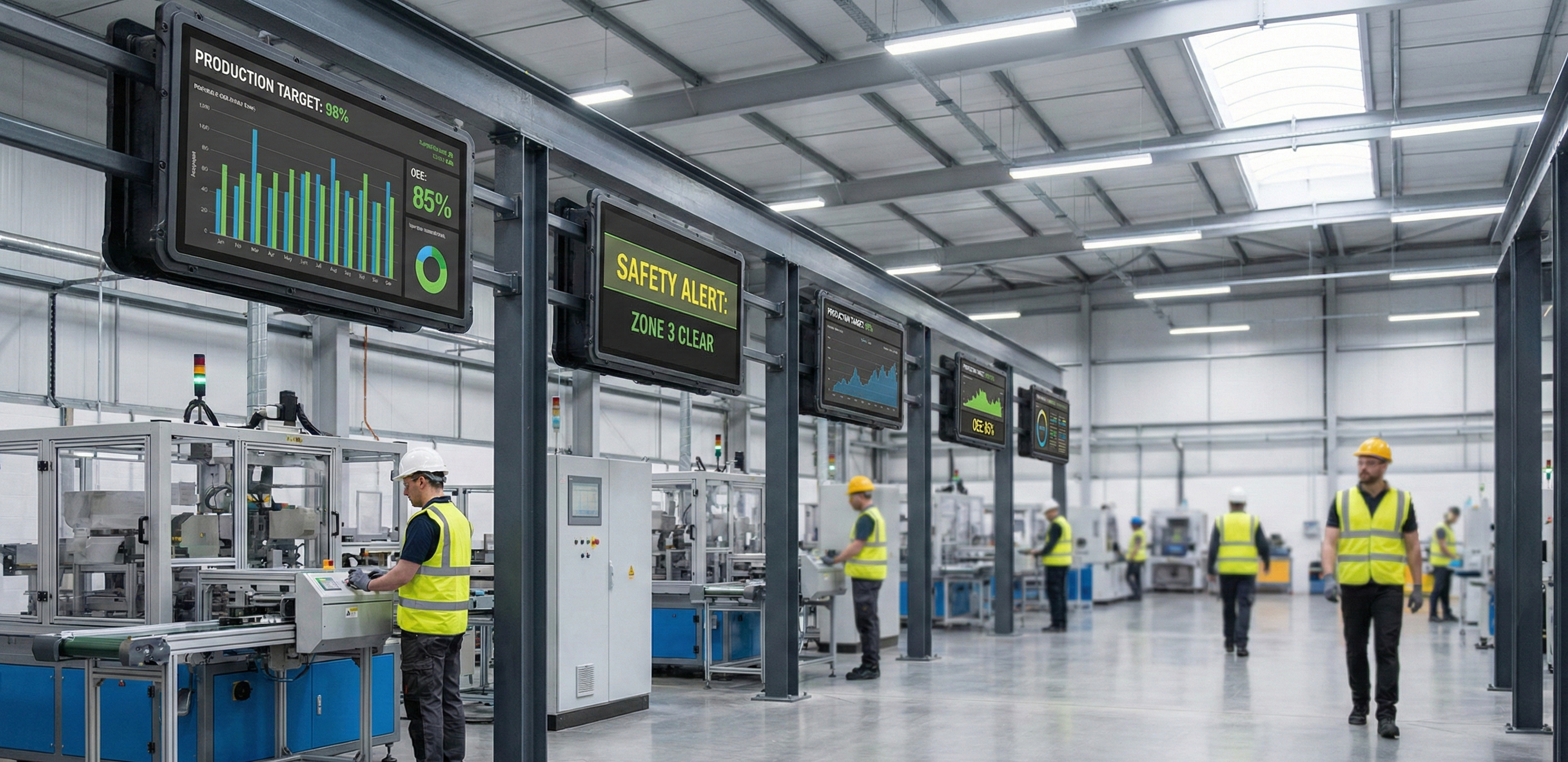
Building a production dashboard on TelemetryOS means connecting to the data sources already running in the facility. The application pulls production counts from the PLC controlling each line via MQTT, quality metrics from the manufacturing execution system through its REST API, and equipment alerts from the SCADA system. A web application running on each display aggregates these feeds and renders the dashboard. The development uses standard web technologies: React components for visualization, WebSocket connections for real-time updates, and the TelemetryOS SDK for offline caching so displays keep showing the last known state during network interruptions.
Environmental monitoring adds another data layer. Temperature and humidity sensors feed into the same display application, triggering automatic warnings when conditions exceed safe operating thresholds. On a summer day when shop floor temperature crosses 95 degrees, displays shift to show heat stress warnings alongside production data. Vibration sensors on critical equipment feed predictive maintenance indicators that flag machines trending toward failure before they break down.
The practical value shows in the feedback loop. When operators see quality metrics drifting on the display above their station, they can adjust before producing a batch of defective parts. When a line falls behind target, the shift lead sees it immediately instead of discovering the shortfall at shift end. The display doesn't replace the MES or SCADA system. It puts the information those systems contain where floor workers can actually see it.
Hazardous Environment Specialization
Chemical processing plants push display requirements furthest. In classified areas where flammable vapors or combustible dust create explosion risk, standard electronics are ignition hazards. Displays in these zones require explosion-proof enclosures certified to ATEX or NEC Class I/II division standards. These enclosures are expensive, often $5,000-$15,000 per location including the enclosure, purge system, and certified installation. But the alternative is no digital communication in precisely the areas where safety procedures and process monitoring matter most.
Inside the enclosure, the display itself can be commercial-grade. The enclosure does the heavy lifting: maintaining positive pressure to prevent vapor ingress, monitoring internal atmosphere, and automatically shutting down if the seal is compromised. Process monitoring applications show real-time data from distributed control systems, giving operators visual status information outside the control room. Safety procedures and emergency response instructions display at relevant locations, updating automatically when operating conditions change.
Food processing creates a different challenge: daily washdown. High-pressure water and chemical sanitizers clean production areas every night. Displays need IP66 or higher ratings with sealed enclosures that prevent moisture ingress while maintaining visibility through anti-glare, chemical-resistant protective screens. HACCP critical control point information, sanitation schedules, and quality standards stay visible throughout production. The cost premium for washdown-rated equipment runs 2-3x over standard commercial displays, but the regulatory consequence of failing a food safety audit because compliance postings were damaged during cleaning justifies the specification.
The Cost Reality
Industrial-grade signage costs substantially more than commercial or consumer alternatives, and organizations should go in with realistic expectations. A single display location in a clean manufacturing environment (sealed enclosure, filtered ventilation, vibration isolation, power conditioning) typically runs $3,000-$6,000 all-in. Hazardous locations requiring explosion-proof enclosures can reach $15,000-$25,000 per location. Washdown-rated food processing installations fall somewhere in between.
These costs make sense for facilities where the signage serves operational functions: production monitoring that reduces response time, safety communication that prevents injuries, or quality displays that catch defects earlier. They make less sense for facilities that just want to show motivational posters or company news. The honest question for any manufacturing signage project is whether the information being displayed justifies industrial-grade protection, or whether a less expensive display in a climate-controlled break room or office area would serve the same purpose.
Smaller facilities with one or two production lines may find the investment difficult to justify. The per-location cost doesn't scale down much because the environmental protection requirements don't change with facility size. A five-display deployment in a machine shop costs nearly as much per screen as a fifty-display deployment in an automotive plant. Organizations with smaller budgets should consider starting with displays in protected areas (control rooms, enclosed offices adjacent to production) where standard commercial hardware survives, then expanding to production floor locations only where operational need is clear.
Practical Deployment Considerations
Site surveys identify environmental hazards before equipment selection, documenting particulate types and concentrations, vibration levels, temperature ranges, electrical interference sources, and ambient lighting conditions. This assessment drives appropriate hardware specifications rather than discovering environmental incompatibilities after installation. A foundry environment requires fundamentally different protection than an electronics assembly facility, and site assessment reveals these differences before equipment purchase.
Installation practices for industrial environments include proper grounding to handle electrical interference, cable routing that protects against mechanical damage and electrical noise, mounting systems engineered for specific vibration and shock loads, and commissioning procedures that verify operation under actual facility conditions. Displays that work perfectly during bench testing may fail immediately in production environments if installation doesn't account for facility-specific challenges.
Maintenance planning for industrial displays includes regular cleaning schedules for enclosures and air filters, vibration isolation inspection and adjustment, power quality monitoring to catch electrical issues before equipment fails, and spare hardware strategies that minimize downtime when failures occur. Manufacturing operations can't afford extended outages while displays ship to repair depots. Facilities maintain spare units or component-level spares that allow rapid replacement and return to operation.
Making Industrial Signage Reliable
Manufacturing digital signage succeeds when deployment treats it as industrial equipment rather than office IT. The environment dictates hardware specifications, installation requirements, and maintenance approaches. Organizations that specify commercial office displays for manufacturing applications experience failure rates that undermine the value proposition entirely. But facilities that assess environmental conditions, specify appropriate protection, and implement industrial installation practices achieve the reliability that makes digital signage operationally valuable rather than perpetually problematic.
TelemetryOS provides platform capabilities for building manufacturing applications that integrate with production systems, safety infrastructure, and facility management platforms. The software runs on appropriate hardware, from consumer-grade media players in climate-controlled offices to industrial computers in sealed enclosures on production floors. Understanding which hardware belongs in which environment, and how to protect it appropriately, determines whether manufacturing digital signage delivers operational value or becomes an expensive maintenance burden.
See TelemetryOS in Action
Explore how leading companies transform their screens