Complete Digital Signage Budget Planning Guide
Discover why 60% of digital signage projects exceed budgets. Learn the complete TCO breakdown, hidden costs, and ROI planning for corporate communications.
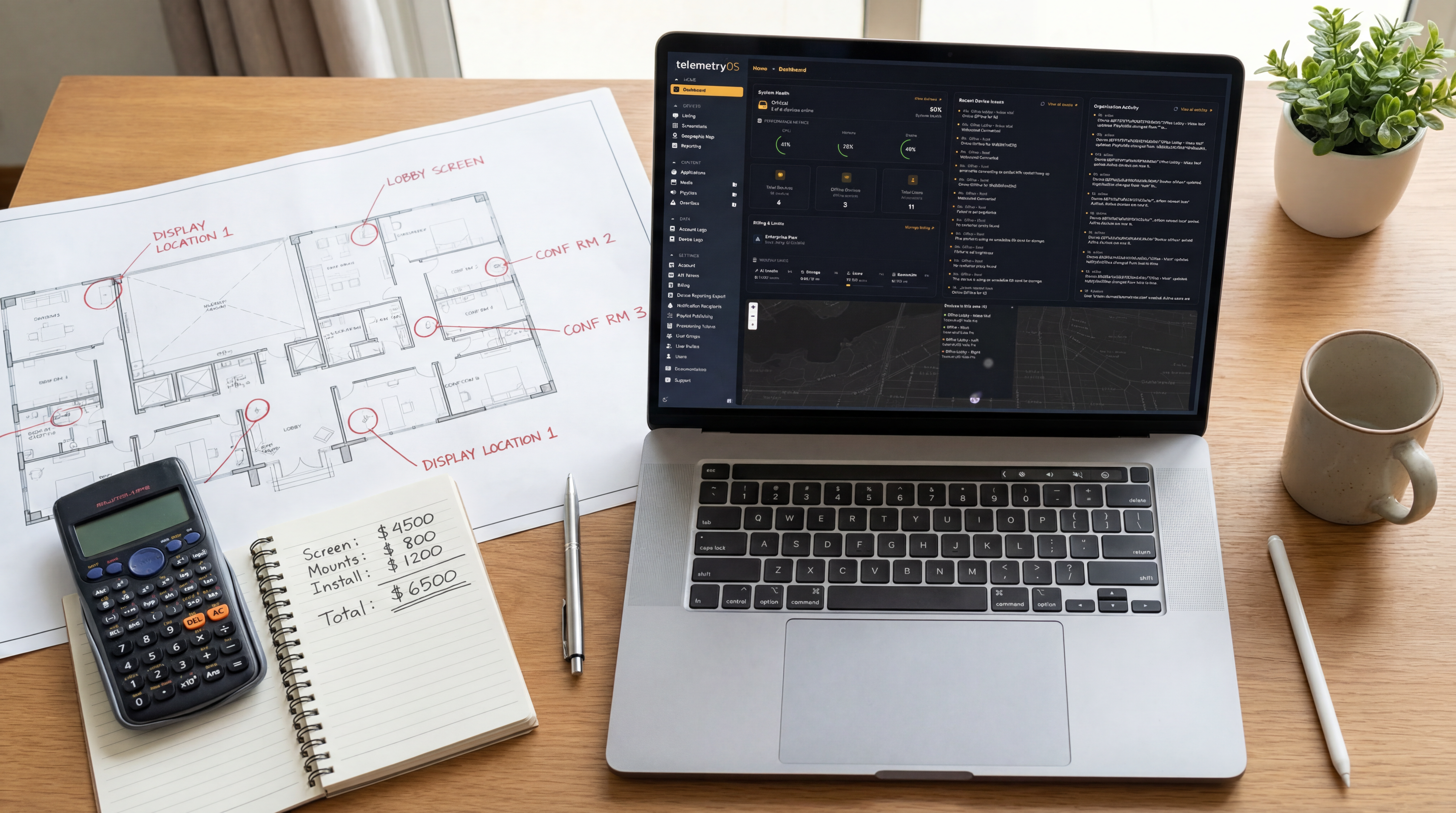
Complete guide to digital signage budget planning covering TCO breakdown, hidden costs that derail 60% of projects, cloud platform economics, ROI calculation, and scaling strategies. Learn to build accurate budgets and avoid common cost overruns.
Complete Digital Signage Budget Planning Guide
When executives approve your digital signage proposal, they expect accurate budgets and predictable costs. Instead, 60% of projects exceed initial estimates, triggering budget reviews and threatening expansion plans. The culprit isn't bad planning—it's hidden costs that emerge only after deployment, turning what seemed like a straightforward investment into an ongoing financial puzzle.
TelemetryOS provides the foundation for building budget-predictable signage solutions. Understanding total cost of ownership upfront transforms budget conversations from defensive explanations to confident projections.
Breaking Down Digital Signage Investment Costs
Digital signage isn't a single purchase—it's an ecosystem of hardware, software, services, and ongoing costs. Most organizations focus on display prices and miss the bigger picture that determines actual spending.
Implementation costs vary based on hardware quality, software capabilities, and deployment complexity. Commercial-grade displays cost more upfront but deliver longer lifespans with warranties designed for 24/7 operation. Consumer-grade alternatives fail faster, creating replacement cycles that cost more over time.
Cloud-based platforms charge monthly per-screen fees that scale with features. Installation varies dramatically by location—multi-floor rollouts require budgeting for mounting, cabling, and network connectivity that add up quickly.
Core budget categories:
- Hardware - Displays, media players, mounting equipment
- Software - Platform subscriptions, content management
- Implementation - Installation, configuration, training
Hidden Costs That Derail Digital Signage Budgets
Budget surprises come from expenses that seem minor individually but compound over time. Knowing these upfront prevents the budget creep that kills expansion plans.
Content creation ranks among the most underestimated expenses. Organizations launch signage assuming someone internally will "handle content" without dedicated resources or realistic time allocation. This amateur approach shows immediately—stale content and poor design undermine the investment before it proves value.
Equipment quality choices haunt you for years. Consumer-grade displays fail faster under continuous operation, triggering emergency purchases and rushed installations. That cheaper initial price tag costs significantly more through replacement cycles and increased maintenance.
Commonly overlooked expenses:
- Content operations - Design tools, stock assets, production time
- Maintenance - Hardware failures, software updates, help desk
- Training - Staff onboarding, documentation, adoption support
Cloud-Based Platforms Reduce Digital Signage TCO
Your software architecture decision shapes long-term costs more than any hardware choice. Traditional on-premise systems require server infrastructure, IT staff, and constant maintenance overhead. Cloud platforms shift to subscription models with predictable monthly costs that include hosting, updates, and support.
Cloud approaches reduce upfront capital expenditure significantly. Instead of purchasing servers and infrastructure, organizations pay monthly fees covering everything from hosting to technical support. This OpEx model often helps with budget approvals by avoiding large capital requests.
Remote device management cuts IT overhead dramatically. Push content updates across locations in minutes, not days of travel and manual installations. Centralized fleet management means one administrator handles what previously required regional teams coordinating schedules and troubleshooting issues independently.
Building Your ROI Case for Digital Signage
Budget approval requires demonstrating return on investment, not just defending costs. For corporate communications, ROI comes from improved employee engagement, reduced communication failures, and operational efficiency that directly impacts the bottom line.
Quantify by identifying specific pain points with dollar values. How much does HR spend printing policy updates that employees ignore? What's the cost of employees missing critical safety information that leads to incidents?
Analytics capabilities turn deployment into proof. Real-time reporting shows content engagement, display uptime, and audience reach—data that proves ROI and identifies optimization opportunities for continuous improvement.
Scaling Economics for Growing Digital Signage Networks
Digital signage costs don't scale linearly. Your 20th location costs far less than your first because infrastructure, processes, and content templates are established. Understanding these economics helps plan multi-year rollouts.
Cloud platforms offer better scaling economics than on-premise systems. Content management remains centralized even as display counts grow, avoiding the exponential staff increases traditional systems require. Volume pricing often reduces per-screen costs as you expand.
Create templates corporate-wide, then allow location customization where needed. This balance maintains brand consistency while respecting local needs—without duplicating effort or multiplying costs unnecessarily.
Building Your Digital Signage Budget Framework
Start with communication objectives, not technology specifications. What problems are you solving with digital signage? How many locations need coverage? These answers drive realistic budget planning that aligns with business goals.
Budget for hardware, installation, software setup, and first-year subscriptions as baseline costs. Include content creation resources—either dedicated staff or outsourced services with defined deliverables. Add training for content managers and administrators who will run the system daily.
Include contingency for unexpected expenses during deployment. Network infrastructure surprises, mounting challenges, and location-specific requirements always emerge. Plan for content tools, stock media, and potential hardware failures outside warranty periods.
Vendor selection impacts costs beyond initial pricing. Low-cost providers may lack features that become critical later, forcing expensive migrations. Enterprise platforms may include capabilities you'll never use, inflating monthly fees unnecessarily.
Look for platforms that provide flexibility without unnecessary complexity. Compliance capabilities matter—SOC 2 Type I and GDPR compliance satisfy IT and legal requirements that could otherwise block deployment.
API integration determines how well signage connects to existing systems. Strong integration reduces manual content updates that consume staff time. Poor integration creates data silos that require constant manual intervention.
Making the Business Case for Digital Signage Investment
Present TCO across 3-5 years, not just year one costs. Show how cloud platforms reduce capital expenditure and provide predictable operating costs that finance teams appreciate. Quantify problems you're solving and assign dollar values to improvements that executives can evaluate.
The true cost of digital signage isn't the price tag—it's the complete investment in transforming how your organization communicates. Understanding TCO upfront, planning for hidden costs, and building scalable architectures turn digital signage from an IT expense into a strategic communication asset that delivers measurable returns year after year.
See TelemetryOS in Action
Explore how leading companies transform their screens