Digital Signage for Emergency Alerts and Crisis Comms
Implement effective emergency communication systems using digital signage with TelemetryOS alerting features and integration capabilities for crisis response.
When emergencies strike, effective communication can save lives—digital signage provides immediate, visible alerts that reach everyone in your facility instantly and reliably.
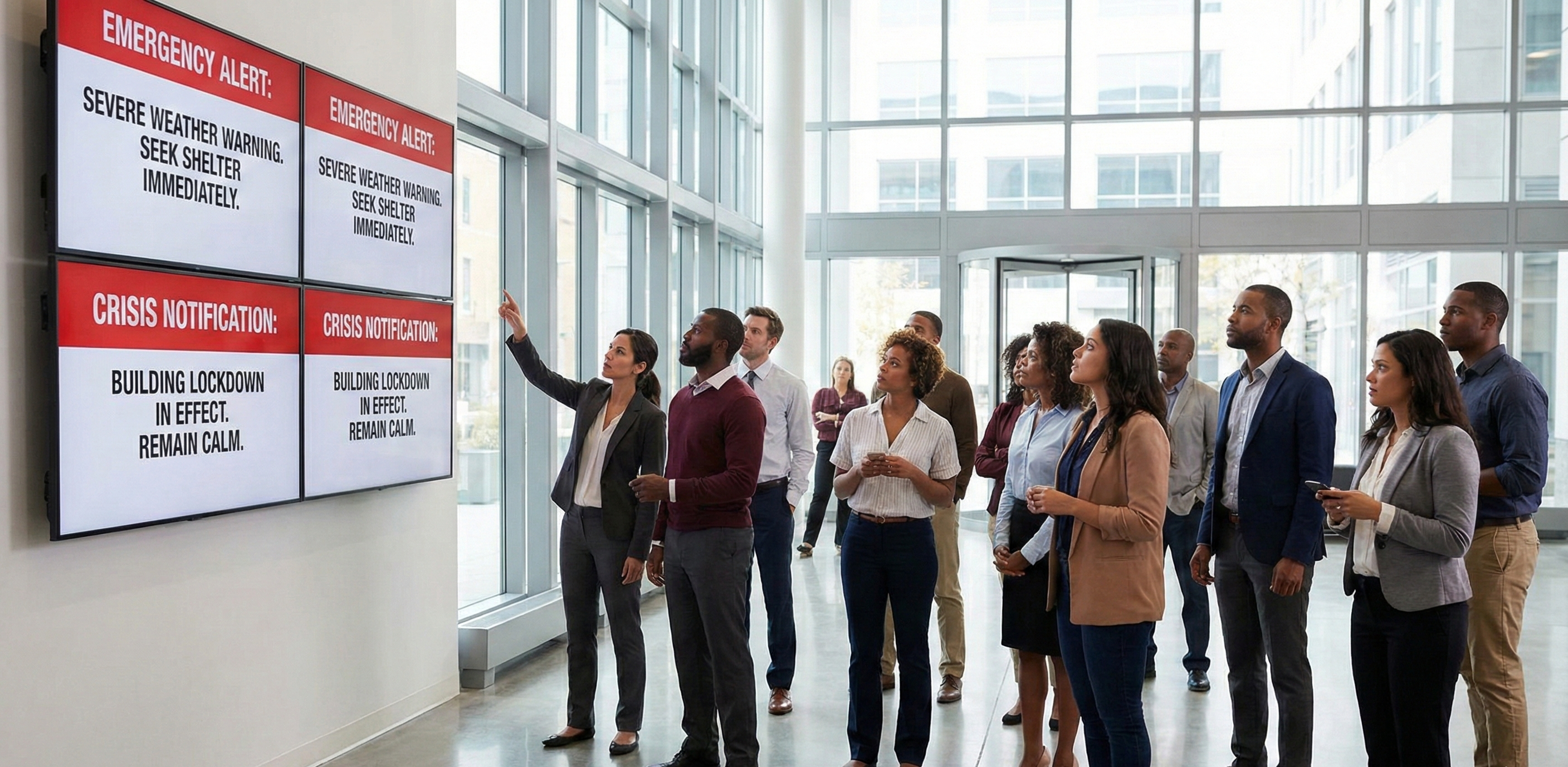
Digital Signage for Emergency Alerts and Crisis Communication
Emergency communication systems face a fundamental challenge: reaching everyone in a facility within seconds, regardless of where they are or what devices they carry. This post examines how digital signage networks address that challenge, what technical capabilities matter most, and where the approach falls short.
Digital signage for emergency communication must override normal content within seconds, deliver safety information to all facility occupants, and continue functioning when primary infrastructure fails. TelemetryOS enables priority override systems that replace all content instantly with emergency alerts, pre-configured templates for immediate deployment without content creation during crisis situations, and offline caching through Node Pro hardware that keeps displays running when network connectivity drops.
Emergency situations require channels that don't depend on individual devices, active monitoring, or specialized equipment. Digital displays complement audio systems while remaining visible during high noise conditions or for hearing-impaired occupants. Information persists on screens so latecomers to affected areas still receive current instructions after initial audio announcements end.
Where Digital Signage Falls Short for Emergencies
Before the technical details, organizations should understand these limitations. They aren't minor caveats. They're structural constraints that determine whether the system works when it matters most.
Coverage gaps are unavoidable. Screens only work where screens exist. Outdoor areas, stairwells, restrooms, and spaces without displays remain uncovered. Every facility has blind spots that require complementary systems like audio announcements, mobile alerts, or visual beacons. Digital signage is one component of a multi-channel emergency plan, not the whole plan.
Power dependency limits reliability. Battery backup and offline caching help, but extended outages exhaust backup systems. Facilities prone to prolonged power loss need methods that don't require electricity at all. The catch: emergencies that cut power are often the same emergencies that demand emergency communication.
False alarm fatigue undermines the system over time. Oversensitive integrations or inadequate filtering train occupants to ignore alerts. Getting the threshold right requires ongoing tuning and may mean accepting slower automated response in exchange for fewer false activations. Organizations that set up integrations and walk away find alert credibility degrades within months.
It's one-way communication. Screens can't confirm that occupants saw alerts or report their status to coordinators. Unlike two-way radio systems or mobile apps with check-in features, digital signage broadcasts without feedback. Any emergency plan relying on digital signage alone has a visibility gap that other systems must fill.
Retrofitting older buildings is expensive. The display hardware is the smaller cost. New electrical circuits, network drops, backup power systems, and integration development add up quickly in buildings without adequate infrastructure.
Trust requires operational discipline. Systems that show outdated alerts, fail to clear after emergencies end, or display generic messages that don't match actual conditions erode occupant confidence. Maintaining trust requires ongoing attention beyond the initial technical deployment.
What Emergency Alerting Systems Need
The technical requirements for emergency alerting differ substantially from everyday digital signage. Priority override replaces all other content immediately without delays from scheduling or approval workflows. When alerts activate, every display shows coordinated information instantly regardless of what was playing. Geographic targeting limits alerts to affected zones when incidents don't impact the entire facility.
Pre-configured templates eliminate content creation delays when staff must focus on response rather than designing graphics. Templates for fire evacuations, severe weather sheltering, security incidents, and medical emergencies activate through simple selection. Multi-modal integration connects digital signage with fire alarm systems, PA announcements, and mobile notifications so messages reach occupants through multiple channels. TelemetryOS enables these capabilities through its alerting infrastructure and integration options.
Additional requirements include backup power to keep displays operational when primary power fails, autonomous operation when networks go down, multilingual support for diverse populations, and clear actionable instructions rather than abstract warnings.
Integration with Emergency Systems
Fire detection integration triggers automatic alerts from smoke detectors, heat sensors, and fire alarms without manual intervention. When building safety systems detect emergencies, displays immediately show evacuation routes, exit locations, and assembly points. This automation matters most when staff are incapacitated or unable to reach controls. Security system connectivity triggers alerts from intrusion detection, access control breaches, or panic button activations.
Weather monitoring provides automatic severe weather alerts from National Weather Service warnings or local weather station data. Tornado warnings and severe thunderstorms trigger shelter instructions without staff manually monitoring conditions. Mass notification integration connects digital signage with platforms coordinating messaging across text, email, social media, and phone trees.
First responder coordination lets emergency services communicate with facility occupants through displays during active response, updating instructions as situations evolve, directing people away from danger zones, or confirming that help is responding. Evacuation management shows real-time routes, exit status when paths become blocked, and assembly points that adapt to changing conditions. Integration with access control and occupancy monitoring makes evacuation guidance responsive to actual building conditions.
Implementation, Training, and Maintenance
Monthly tests should verify communication pathways, content display accuracy, and integration functionality. Quarterly drills should test complete emergency procedures including digital communication, revealing gaps before actual emergencies expose them.
Redundancy protects communication when primary infrastructure fails. Battery backup power keeps displays operational during outages. Redundant network connections through diverse routing and backup cellular provide alternate pathways. Node Pro devices cache emergency content locally, so alerts function during complete network failures. Backup power systems need regular load testing to confirm they work under real conditions, not just on paper. These redundancies matter because emergencies often compromise exactly the systems organizations depend on normally.
Train multiple staff members across all shifts on alert activation. Primary operators may be unavailable during an actual emergency. Simple, rehearsed procedures reduce confusion when stress compresses decision timelines. Training should cover both technical operation and coordination with broader crisis management.
Clear escalation procedures define who can activate different alert types and how to coordinate with local emergency services. These procedures prevent both over-activation that creates fatigue and under-activation that leaves people uninformed. Compliance verification covers ADA accessibility standards for visual alternatives to audio-only announcements, local requirements that vary by jurisdiction, and industry-specific regulations for healthcare, education, and other environments with heightened life-safety obligations.
Coordinate with local fire departments, police, and EMS so facility communication aligns with broader response procedures. Facilities and external responders issuing conflicting instructions during active emergencies creates dangerous confusion. Post-incident analysis after actual emergencies or major drills identifies what worked and what failed, driving continuous improvement.
Preventive maintenance keeps systems ready through regular testing of all components: displays, power systems, network connectivity, and integrations. Don't wait for an actual emergency to discover a failed display or drained battery. Document everything for compliance reporting and ongoing system improvement.
TelemetryOS enables building emergency communication systems that meet regulatory requirements, function under worst-case conditions, and integrate with crisis management procedures where communication effectiveness directly impacts safety outcomes.
See TelemetryOS in Action
Explore how leading companies transform their screens