Integrating TelemetryOS with Point-of-Sale Systems
Learn how to connect TelemetryOS with POS systems for real-time menu updates, promotional displays, and seamless customer experiences.
When your digital displays need to show current pricing, availability, and promotions that change throughout the day, POS integration ensures your signage always matches your sales system.
Integrating TelemetryOS with Point-of-Sale Systems
TelemetryOS connects to POS systems through standard REST APIs, updating menu boards and promotional displays within seconds of price changes in the sales system. For QSR operators managing lunch rushes across 200 locations, that speed eliminates the lag between when a manager changes pricing and when customers see the update, a gap that previously cost minutes of confusion at every register during promotional transitions.
The integration works through bidirectional data exchange where POS systems push pricing, inventory, and promotional data to TelemetryOS applications running on displays. Those applications transform transaction data into customer-facing content automatically, without requiring staff to update signage manually. A breakfast menu switches to lunch offerings at exactly 10:30 AM because the POS system signals the transition, not because someone remembered to make the change.
The Business Case for Real-Time POS Integration
When menu boards show $8.99 but the register charges $9.49, customer trust erodes faster than staff can explain the discrepancy. Manual pricing updates create these disconnects constantly: someone changes the POS but forgets the signage, or updates displays but mistypes a number. Each discrepancy wastes 30-45 seconds of transaction time while cashiers apologize and managers intervene. Across a busy location processing 800 transactions daily, those seconds accumulate to hours of lost productivity and dozens of frustrated customers.
POS integration eliminates these disconnects by treating the POS system as the single source of truth. When a manager updates a promotional price in the POS system, that change propagates to every connected display within 90 seconds. The same automation applies to inventory availability: when the kitchen marks an item as 86'd in the POS, those displays showing that item automatically switch to alternative offerings or remove the unavailable product from promotional rotation.
This synchronization goes beyond pricing accuracy. Loyalty program integrations enable displays to show personalized offers based on customer purchase history, promotional calendars activate limited-time offers automatically based on POS campaign settings, and sales performance data drives dynamic content prioritization where high-margin items receive more prominent display placement during slower periods. The signage network becomes an extension of the POS system rather than a parallel system requiring separate management.
Technical Architecture and Data Flow
Modern POS systems expose APIs that provide read access to product catalogs, pricing tables, inventory levels, and promotional schedules. TelemetryOS applications connect to these APIs using OAuth authentication or API keys, polling for updates on schedules that balance data freshness with network efficiency. For time-sensitive information like pricing changes, webhook notifications enable immediate updates rather than waiting for the next polling cycle.
The integration handles data transformation between POS formats and display requirements automatically. A POS system stores a menu item as "CHZBRGR_LG" with a price of 8.99 and category code 102, while the display application needs that item rendered as "Large Cheeseburger" with "$8.99" formatting and placement in the "Burgers" menu section. TelemetryOS applications perform this transformation using business logic developers define, ensuring that POS data appears on screens in customer-friendly formats that match brand standards.
Offline resilience protects against network outages and POS system downtime. Node Pro devices cache the most recent pricing and menu data locally, continuing to display accurate information even when connectivity to the POS system drops. When connection restores, automatic synchronization updates local caches with any changes that occurred during the outage. This approach ensures temporary network issues don't leave screens showing stale content or defaulting to generic placeholder displays.
Error handling addresses common failure modes through fallback strategies. When a specific menu item's price fails to update due to data format issues, the display retains the previous known-good price rather than showing error messages or blank spaces to customers. Logging captures these failures for IT investigation while preventing customer-facing disruptions. Alert thresholds notify administrators when update failures exceed acceptable levels, enabling proactive intervention before customers notice problems.
Implementation Patterns Across Verticals
QSR chains deploy POS integration for daypart menu transitions where breakfast, lunch, dinner, and late-night menus switch automatically based on time-of-day settings in the POS system. Limited-time offers appear on menu boards when promotional campaigns activate in the POS and disappear when campaigns expire, eliminating the manual coordination previously required between marketing, operations, and IT teams. Combo meal pricing updates across all components simultaneously, ensuring that individual item prices and bundled pricing remain consistent.
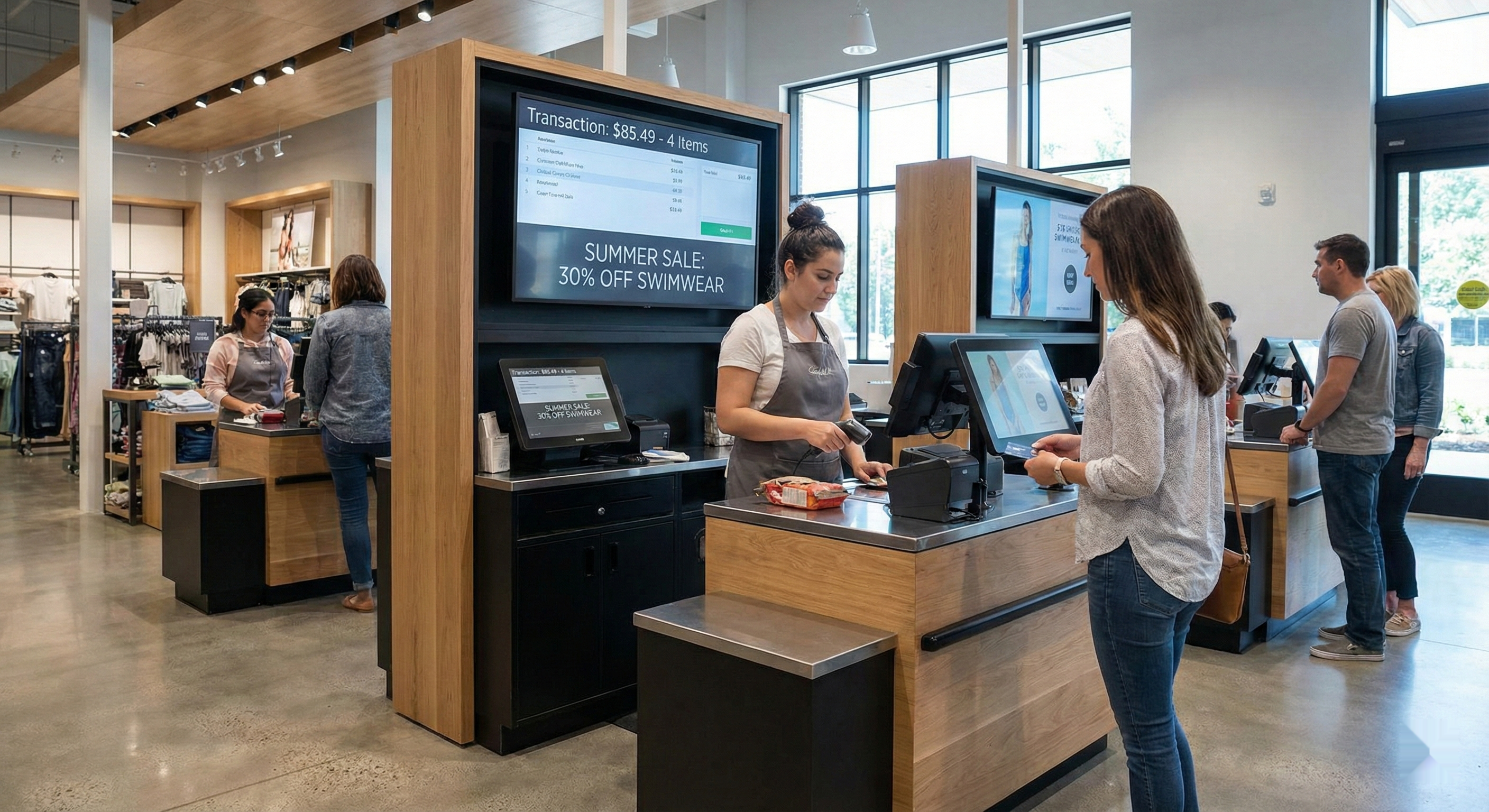
Retail environments use POS integration for dynamic pricing displays that reflect sale events, clearance pricing, and inventory-based promotions. When a product reaches the markdown threshold in the inventory system, connected displays automatically begin showing the clearance price. BOPIS (Buy Online, Pick Up In Store) inventory displays pull real-time availability from POS systems, showing customers exactly which products are available for immediate pickup at their current location rather than displaying stale availability that leads to fulfillment failures.
Coffee shops use POS integration for seasonal menu management where new drink offerings activate across all displays when the POS menu updates for seasonal rollouts. Ingredient-based availability works through POS inventory tracking: when oat milk inventory drops below the reorder threshold, displays stop promoting oat milk drinks automatically. Loyalty tier benefits display based on the customer identification methods the POS system supports, creating personalized upsell opportunities at the moment of decision.
Pharmacy operations integrate prescription management systems with patient notification displays, showing "Prescription Ready" messages based on fulfillment status while maintaining HIPAA compliance through patient ID verification. Health screening promotions activate based on seasonal public health campaigns configured in the pharmacy management system. Medication availability notifications prevent customers from waiting for out-of-stock prescriptions by displaying expected restock dates automatically.
Configuration and Deployment Considerations
Successful POS integration starts with API capability assessment. Organizations need to verify that their POS system provides API access with sufficient rate limits for real-time updates, supports webhook notifications for immediate change propagation, and includes the specific data fields required for display applications (pricing, availability, promotional metadata). Some POS systems require vendor permission or additional licensing to enable API access, making early verification critical to project timelines.
Network architecture affects integration reliability and performance. Displays and POS systems operating on the same local network enable faster update propagation and reduce dependency on internet connectivity for local operations. Firewall rules need configuration to permit API traffic between TelemetryOS devices and POS systems, and bandwidth allocation should account for peak update periods when many displays request data simultaneously during menu transitions or promotional launches.
Security requirements mandate encrypted connections (TLS 1.2 or higher), credential rotation schedules that limit exposure from compromised API keys, and role-based access controls that restrict POS data access to only the information necessary for display functions. Payment card industry (PCI) compliance considerations apply when displays access POS systems that process payment data, though TelemetryOS applications typically need only menu and pricing data rather than transaction details.
Testing procedures validate integration accuracy before production deployment. Pilot installations at one or two locations enable verification that pricing updates propagate correctly, timing aligns with operational requirements, and error handling prevents customer-facing issues. Parallel operation periods where staff verify that display information matches POS data build confidence before full network rollout. Load testing ensures that the POS system's API can handle request volumes from a full display network without performance degradation.
Limitations and Integration Challenges
POS integration introduces dependencies that create new failure modes. When the POS API experiences latency or partial outages, displays may show stale data without clear indication to staff or customers that information is outdated. Organizations must decide how to handle these states: continue showing cached data, display a timestamp indicating last update, or switch to static fallback content. Each approach has tradeoffs between customer experience and transparency.
Data quality issues in the source POS system propagate directly to displays. If a manager mistypes a price in the POS, that error now appears on every connected screen within seconds rather than remaining isolated at the register. Automation amplifies mistakes at the same speed it amplifies correct changes. Some organizations implement approval workflows or delay windows for price changes, but these add friction that reduces the responsiveness benefits that motivated the integration.
Not all POS systems provide equal API capabilities. Legacy systems may offer limited data fields, impose restrictive rate limits, or require expensive middleware to expose the information displays need. Some franchisee-operated locations use different POS vendors than corporate locations, creating integration fragmentation across a network. Organizations sometimes discover these limitations only after committing to an integration approach, leading to scope changes mid-project.
Maintenance burden accumulates over time. POS vendors update their APIs, sometimes deprecating endpoints or changing data formats without extensive notice. Display applications require updates to match these changes, and the coordination between POS vendor roadmaps and signage development cycles rarely aligns cleanly. Organizations should plan for ongoing integration maintenance rather than treating the initial connection as a one-time project.
Measuring Integration Value
Organizations measure POS integration ROI through multiple metrics. In typical deployments, pricing accuracy improves from roughly 85-90% consistency (with manual updates) to 99%+ consistency with automated synchronization, though actual results vary significantly based on previous manual processes and staff discipline. Transaction resolution time decreases when pricing discrepancies drop, though quantifying the exact savings requires baseline measurement before integration.
Staff time savings depend heavily on previous update frequency and menu complexity. Locations with stable pricing and infrequent promotions see modest time savings, while high-velocity environments with multiple daily menu changes may recover several hours of manual work weekly. Customer satisfaction improvements, while commonly reported, prove difficult to attribute solely to pricing accuracy versus other concurrent operational changes.
Promotional effectiveness increases when displays show current campaigns automatically. Organizations report higher promotional item sales at locations with POS-integrated displays compared to manual update locations, primarily because integrated locations never miss promotional updates and promotions activate precisely at campaign start times. The magnitude of improvement varies by promotion type and baseline operational discipline.
Where POS Integration Leads
The convergence of transaction systems and display networks raises questions that go beyond technical implementation. As real-time data flows more freely between operational systems and customer-facing surfaces, where should the boundaries of automation lie? When a display can adjust pricing based on inventory, demand patterns, and competitive data simultaneously, the distinction between dynamic signage and algorithmic pricing blurs. Organizations integrating POS systems today are building infrastructure that will need to accommodate these capabilities tomorrow, whether they intend to use them or not.
See TelemetryOS in Action
Explore how leading companies transform their screens