Managing Multi-Site Deployments with TelemetryOS
Learn centralized management strategies for multi-location digital signage networks using TelemetryOS tools and best practices for scalable operations.
When your digital signage spans multiple locations across different regions, centralized management tools ensure consistent messaging and operational efficiency without sacrificing local customization needs.
Managing Multi-Site Deployments with TelemetryOS
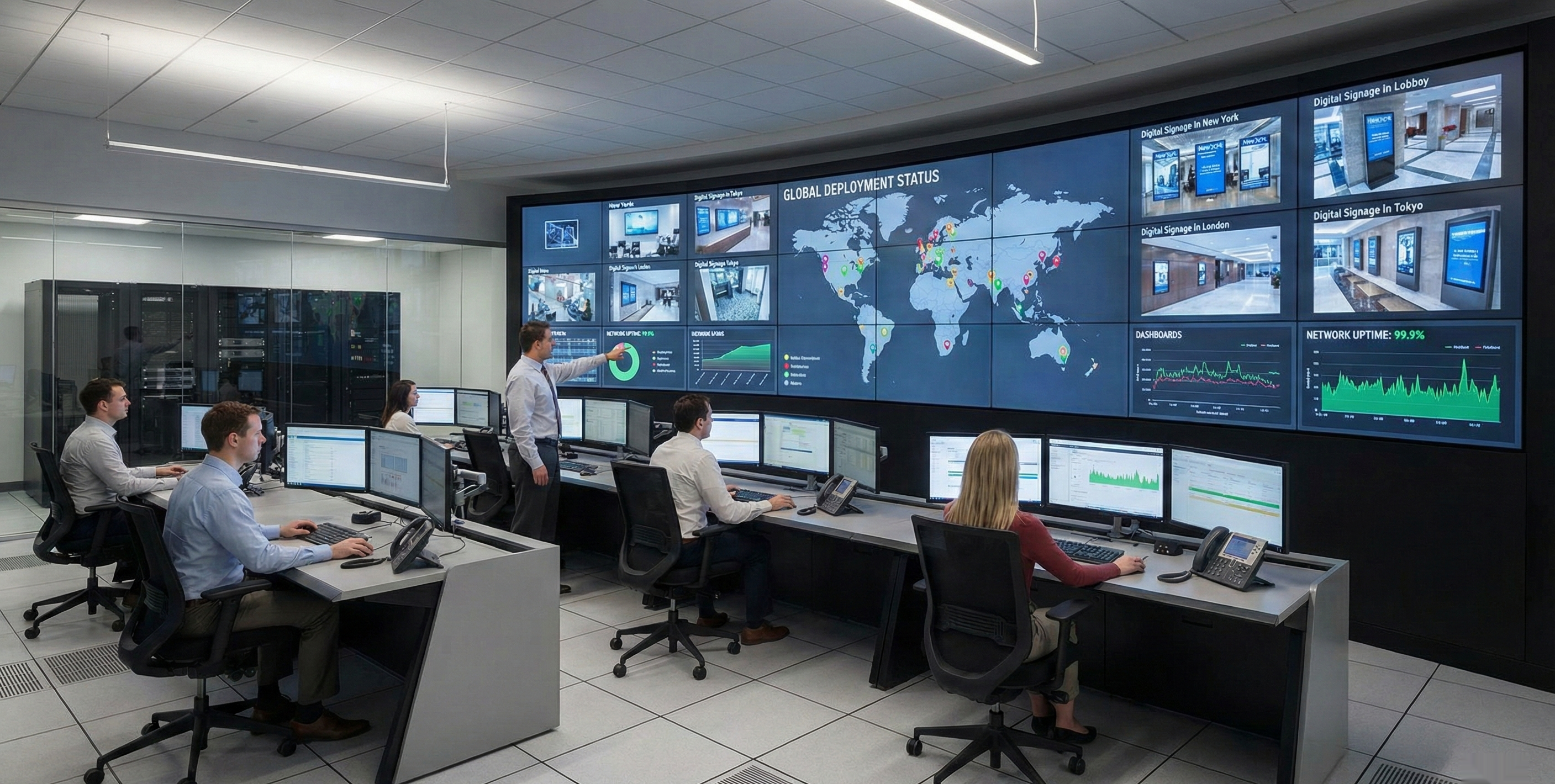
A retail operations manager opens a centralized dashboard at 6 AM on Black Friday, schedules promotional content for 200 stores across four time zones, and confirms deployment to every display before the first store opens. All from a single interface. The previous workflow had regional managers spending hours coordinating with individual store teams to ensure promotional consistency, a process that frequently resulted in delayed rollouts and brand inconsistencies across locations.
Multi-site digital signage management at scale requires balancing corporate oversight with local flexibility. National campaigns need consistent execution while individual locations require autonomy for region-specific content, local events, and store-specific information. The challenge grows across industries where healthcare networks manage patient communication across dozens of facilities, restaurant franchises coordinate promotions while accommodating franchisee customization, and corporate office networks deliver internal communications across global locations with different languages and compliance requirements.
Centralized Control with Hierarchical Permissions
TelemetryOS structures multi-site management through organizational hierarchies that mirror business operations. A corporate administrator creates content templates and brand standards that cascade down through regional divisions to individual locations. Regional managers inherit corporate content while adding market-specific overlays, and location managers customize within parameters corporate defines. This hierarchy ensures brand consistency while enabling appropriate local adaptation.
The permission system operates through role-based access control where different user roles carry specific capabilities. Corporate administrators deploy network-wide updates and configure brand guidelines that lower tiers cannot override. Regional managers access locations within their geography and modify content within corporate parameters. Location managers control only their assigned sites and customize approved content zones without affecting corporate messaging. This granular control prevents unauthorized changes while distributing management responsibility efficiently.
Content inheritance works through template systems where corporate creates base content that locations use as starting points. A retail chain might create a promotional template at corporate level with national pricing and imagery, then enable regional managers to override pricing for markets with different cost structures while maintaining visual consistency. Location managers add store-specific information like hours and contact details without rebuilding entire layouts. Changes to corporate templates propagate automatically to all locations inheriting that template, ensuring updates deploy consistently.
Bulk operations enable efficient network-wide management for administrators overseeing hundreds or thousands of displays. Instead of updating devices individually, administrators apply changes to location groups, regional segments, or the entire network with single operations. A software update scheduled for midnight deploys to all devices across time zones at their local midnight, avoiding disruption during business hours. Content campaigns activate simultaneously across target locations regardless of their number or geographic distribution.
Scaling Operations Without Scaling Headcount
Organizations operating 50 locations face fundamentally different management challenges than those with 500 or 5,000 displays, yet headcount doesn't scale linearly with network size. A company managing 100 stores might dedicate one full-time employee to digital signage operations, while a company managing 1,000 stores often operates with two or three people through automation and centralized tools.
Standardization reduces operational complexity at scale. When every location uses identical hardware configurations, troubleshooting becomes systematic rather than location-specific. When network architecture follows consistent patterns, adding new locations replicates proven implementations rather than requiring custom design. When operational procedures are consistent across regions, training transfers easily and best practices replicate efficiently. Organizations that resist standardization in favor of location-specific approaches find themselves unable to scale without proportionally increasing support staff.
Automated monitoring detects issues before they affect operations. TelemetryOS tracks device health metrics including display connectivity, content synchronization status, storage capacity, and system temperature across entire networks. When a device's available storage drops below defined thresholds, the system alerts administrators days before the issue prevents content updates. When a display loses network connectivity, automated alerts enable proactive investigation rather than waiting for location staff to report problems. This monitoring scales to thousands of devices without requiring proportional increases in staff checking device status manually.
Phased rollout strategies minimize risk when deploying changes across large networks. Organizations test new content or system updates with pilot location groups before network-wide deployment, catching issues that only emerge in production environments. Gradual expansion enables optimization based on real-world feedback while preventing widespread problems. A retail chain rolling out new interactive kiosk applications might deploy to 10 stores initially, expand to 100 stores after two weeks of successful operation, then complete network deployment over the following month as confidence builds.
Content Governance at Enterprise Scale
Content quality and brand consistency matter more as networks grow larger. A single location showing off-brand content or outdated information reflects poorly on the entire organization, but reviewing every content change manually becomes impossible at scale. Automated governance systems enforce standards without creating approval bottlenecks.
Approval workflows route content through appropriate stakeholders based on content type and scope. Corporate-level campaigns require executive approval before deployment, while location-specific content needs only local manager approval. Workflows can enforce brand compliance checking where content management systems validate color schemes, typography, and logo usage against brand guidelines automatically. Content that violates standards gets flagged before reaching displays, preventing brand inconsistencies without slowing content creation.
Template systems constrain customization to approved parameters. A restaurant franchise might provide menu board templates where franchisees can modify pricing, hours, and location-specific information but cannot change layout, colors, or national brand messaging. This gives franchisees control over their content while keeping corporate brand standards intact. Template violations trigger alerts when someone attempts changes outside approved zones, enabling intervention before problematic content reaches customer-facing displays.
Version control and audit trails track content changes across the network over time. When questions arise about what content displayed at specific locations during particular timeframes, audit logs provide definitive answers. Compliance requirements in regulated industries often mandate proof of what information was displayed when and where, making audit capabilities necessary rather than optional. TelemetryOS maintains these records automatically without requiring manual documentation.
Technical Infrastructure for Multi-Site Reliability
Network architecture affects multi-site reliability fundamentally. Organizations with centralized cloud management can update thousands of displays simultaneously, but they depend on internet connectivity at every location. Network outages don't stop displays from functioning when devices cache content locally. Node Pro devices store content on-device and continue displaying through connectivity gaps, synchronizing updates automatically when connections restore.
Content delivery networks optimize bandwidth usage across large deployments. Instead of every device downloading identical content files from central servers simultaneously, TelemetryOS can stage content regionally where devices in geographic clusters share content efficiently. This reduces internet bandwidth consumption at individual locations while accelerating content deployment. A retail chain updating holiday promotional videos across 500 stores transfers that content once per region rather than 500 individual downloads.
Remote troubleshooting eliminates the majority of on-site visits. One hospitality operator managing 50 properties reported cutting on-site support calls by roughly 75% after implementing remote diagnostics. IT teams access devices remotely for configuration changes and software-level repairs, while device logs, system metrics, and screen captures enable investigation of problems that previously required physical visits. Only hardware failures and physical installation issues still require on-site presence.
Challenges and Limitations of Multi-Site Management
Centralized management introduces its own failure modes that organizations should anticipate. A misconfigured bulk operation can propagate errors across hundreds of locations faster than manual processes ever could. The same efficiency that enables rapid deployment also enables rapid mistakes. Organizations need rollback procedures and validation checkpoints proportional to the scale of changes being deployed.
Network dependency creates a different risk profile than location-independent systems. While Node Pro devices cache content locally and continue operating through connectivity gaps, extended outages prevent content updates and limit remote monitoring visibility. Organizations with unreliable network infrastructure at some locations may need to design around those constraints rather than assuming uniform connectivity.
Standardization, while necessary for scale, conflicts with legitimate local variation. Franchisees may have valid reasons for different operational hours, regional pricing, or local compliance requirements that don't fit neatly into corporate templates. Finding the right balance between enforcement and flexibility requires ongoing negotiation rather than a one-time configuration decision.
Training and change management complexity increases with geographic distribution. A 500-location network spans different time zones, languages, and local management cultures. Deploying new features or workflow changes requires coordinated communication across these variations, and user adoption rates often vary significantly by region even with identical training materials.
Measuring Multi-Site Management Efficiency
Organizations measure multi-site management effectiveness through several metrics. Content deployment time tracks how quickly campaigns reach all target locations. Manual processes at scale might require days or weeks, while automated deployment completes in minutes to hours regardless of network size. Content accuracy measures consistency between intended content and what actually displays across locations, where manual processes often struggle while automated systems can approach near-perfect accuracy.
Support ticket volume per display indicates how much ongoing attention each device requires. Well-managed networks with effective centralized tools tend to generate fewer support tickets per device than networks relying on location-by-location troubleshooting. This difference represents substantial support cost variation at scale, though actual numbers depend heavily on device types, environmental conditions, and how organizations define and track support incidents.
A restaurant chain managing 150 locations previously required regional coordinators spending 10-15 hours weekly on digital signage coordination, plus location managers spending 2-3 hours weekly on content updates. After centralizing management, the chain consolidated oversight to a single operations team, reducing location manager involvement to brief weekly check-ins focused on local customization rather than technical management.
The real question for organizations scaling their display networks isn't whether centralized management tools provide value, but how to design hierarchies, permissions, and governance structures that balance corporate control with local autonomy as the network grows. Getting that balance wrong creates either brand inconsistency or franchisee resentment, and the right answer varies by industry, ownership structure, and organizational culture. The tools exist; the organizational design work remains the harder challenge.
See TelemetryOS in Action
Explore how leading companies transform their screens